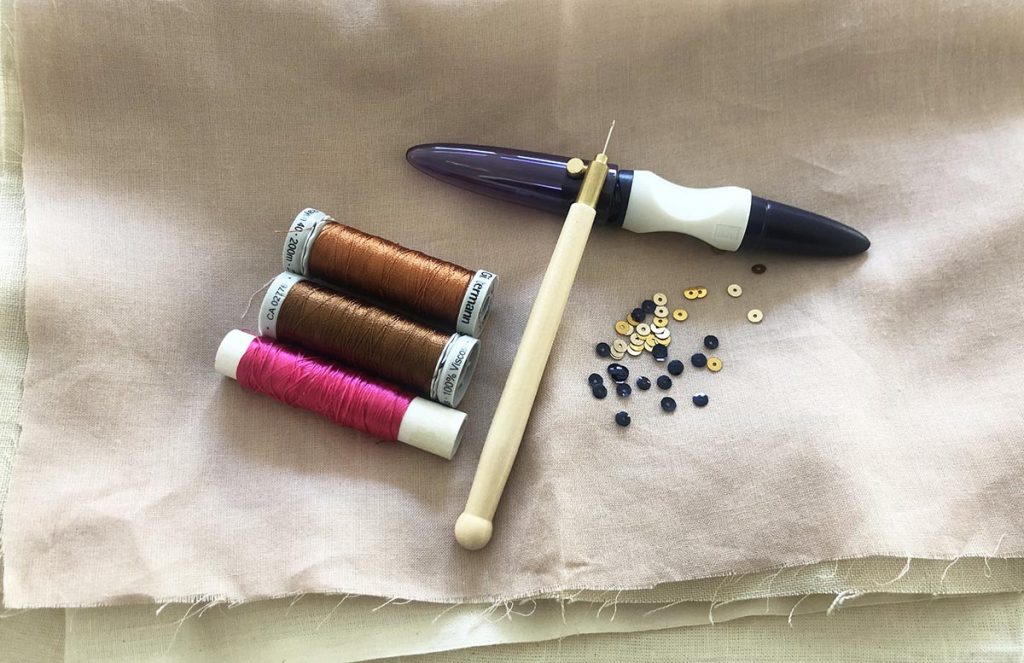
Tambour Embroidery Course at Hand and Lock
A craft skill cannot be learned in a purely cognitive manner. Sometimes, your hands will make the discovery first, and your mind will catch up later.
Written by Sonya Ahmed, 16 December 2019
Hand and Lock Embroidery Atelier
After a tough week at work, I was looking forward to two days of blissful, stitchy happiness. I had booked a weekend course – Introduction to Tambour Embroidery – at Hand and Lock, a premier embroidery atelier, in central London.
Hand and Lock has been providing embroidery services for 250 years. Clients include the military, royalty, established fashion houses, such as Dior and Louis Vuitton, and independent designers such as Mary Katrantzou and Erdem.
When Mr Hand set up his business in 1767, little did he imagine that 250 years later, a small Asian woman, in a puffy coat and gold trainers, would be speeding through London, on an underground train, to spend a weekend learning tambour.

Tambour embroidery is carried out using a hook, rather than a needle. In India, a similar technique is called Aari embroidery. At home, using a needle and thread, I couldn’t produce the beautiful and tiny chain stitches used in aari, and I wondered if the hook would allow for finer stitches and more complex designs.
Hand and Lock provided everything I needed for the two days, so I didn’t have to buy anything in preparation for the course. The large, wooden frames were set up before we arrived and we were each given a pack, containing an instruction booklet, a pair of scissors and a wooden tambour hook.
Our tutor, Justine, had trained at Ecole Lesage, a world-renowned haute couture embroidery school in Paris.

Photo – Sonya Ahmed
Day 1 – Chain Stitching
Justine started with a demonstration of the basic chain stitch. Her movements were smooth and she made it look easy, yet I would spend the next two days struggling to do this basic stitch!
Back at my frame, I spent the first few minutes trying to ‘thread’ the hook, before realising there was no hole. A tambour hook has a wooden handle with a metal hook at the end. The thread is picked up and dropped off the hook with each stitch. This allows for speedy embroidery and beading.
The process sounds straightforward – wrap thread round hook, rotate hook, pull hook up through fabric – but the hook kept snagging on the delicate gauze and required persistent tugging to pull it through the fabric. Each time I rotated the hook, the thread fell off. I would try, with surgical precision, to pick up the tiny loop. If I missed, it would disappear through the fabric and whole line of stitches would unravel.

The regular ‘oofs’ from others in the room assured me that I wasn’t alone in my frustration. Justine walked around, ordering us to ‘relax’, but she wasn’t trying to force us into a zen-like state. She was asking us to loosen our hold on the thread, so that the hook could glide through the fabric.
I spent most of the day trying to get the hang of the stitching. Justine pointed out, multiple times, that if I slowed down and worked with more precision, my stitching would improve. The idea of doing something slowly and purposefully, without any sense of urgency, is something that most of us have forgotten how to do. Each time I slowed down, my stitches improved, but it was hard to avoid speeding up again.
The other problem was that the thread kept falling off the hook. I rarely managed an entire stitch in one go. It was infuriating. It was only in the last hour of Day Two, that I discovered how to stop this. If I applied some tension to the thread and pulled the entire loop round, rather than rotating the hook inside the loop, I could stop the thread from falling off.
It’s ok if that doesn’t make sense. A craft skill cannot be learned in a purely cognitive manner. Sometimes, your hands will make the discovery and your mind will catch up later. The first time I managed two stitches in a row, I was ready to throw a party!
Day 2 – Beads and Sequins
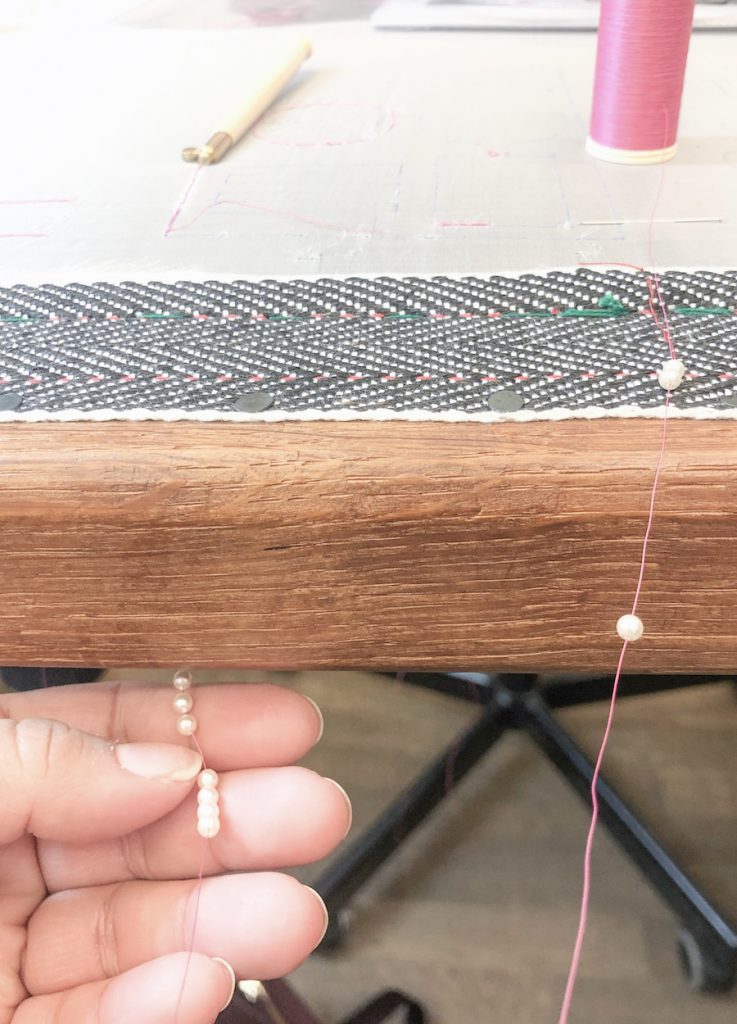
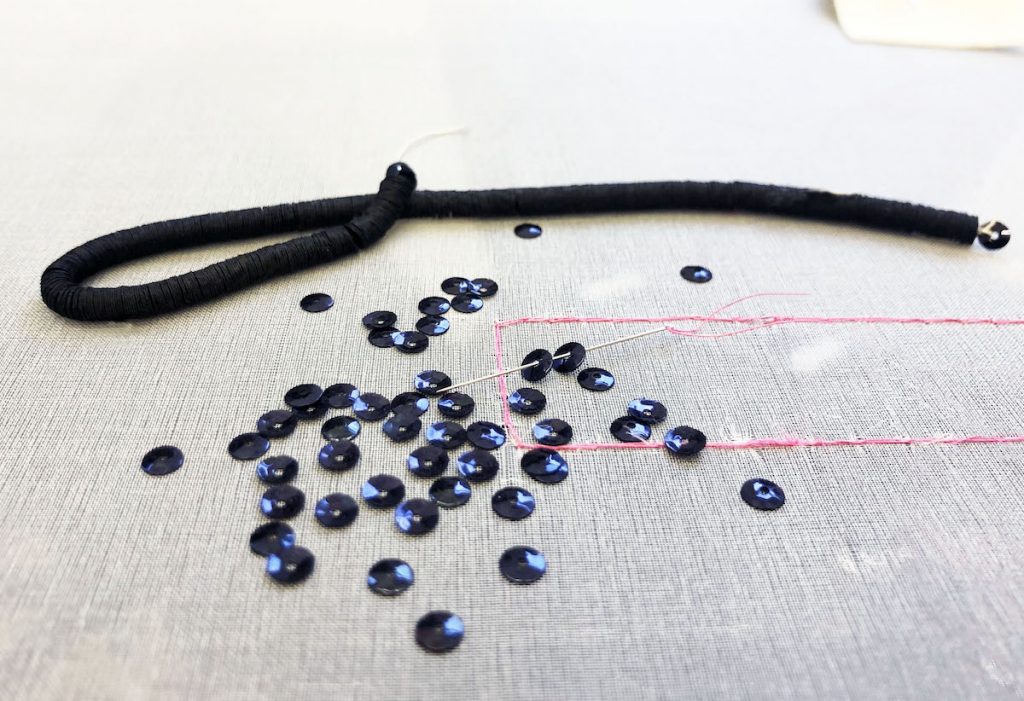
Day 2 was spent learning to sew beads and sequins onto the gauze. In tambour embroidery, you work on the back of the fabric, so the beads are held under the frame. The transparent gauze, used to learn tambour, allows you to see what you are doing. Beads are tricky and very small. They kept slipping out of my fingers and sliding back down the thread. On occasion, they would fling themselves onto the floor.
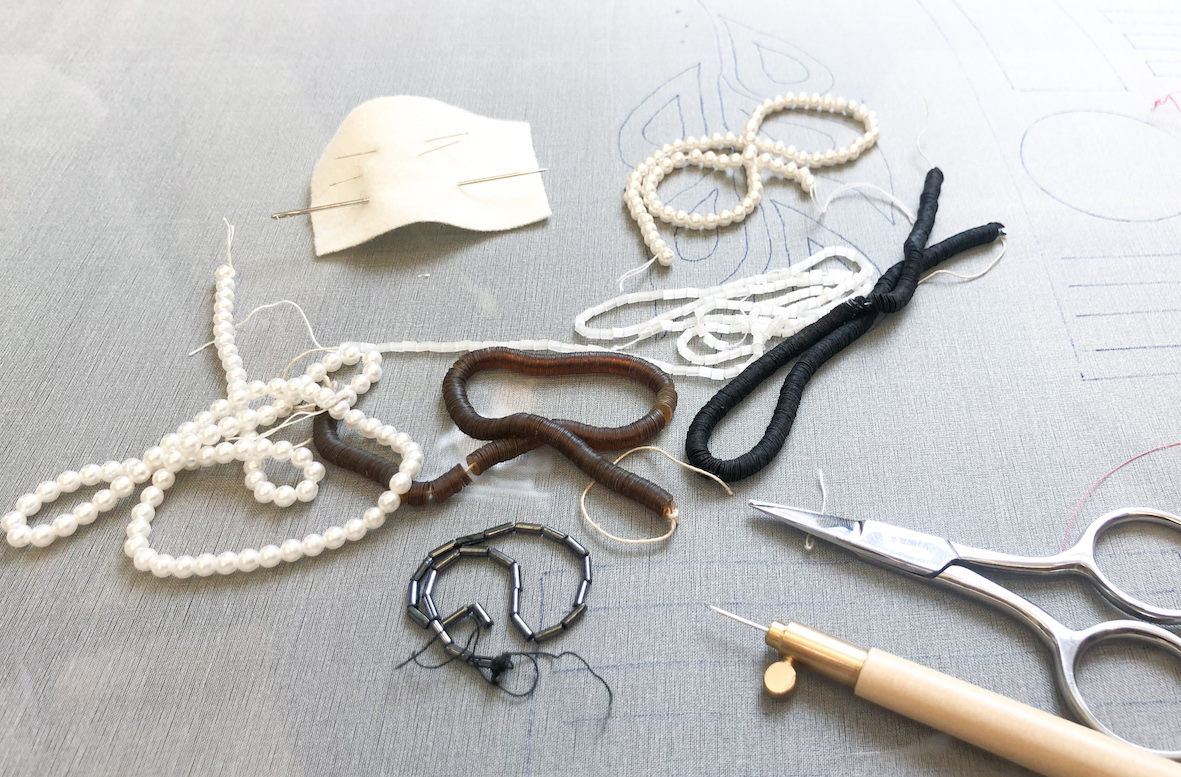
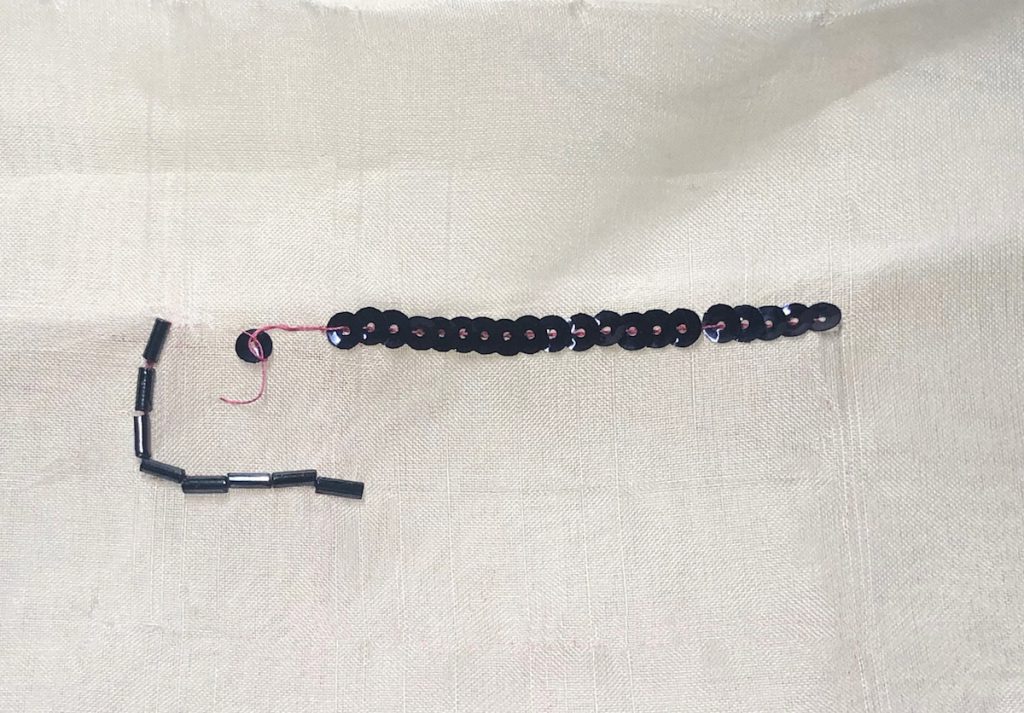
I learned which way round sequins need to be sewn onto the fabric and the distance between stitches to make sure the hole in the middle of the sequin is not visible. I learned to make sharp corners with beads and sequins by making short, anchoring stitches, and how to do ‘stop and start’ stitches to secure the thread.
It’s not easy to spend hours bent over a frame. I put the hook down every 20 minutes or so for a stretch and iphone break. The pace of the course was good and I didn’t feel any pressure to keep up with the others. I spent a lot of time trying to get the hang of the stitching and didn’t make huge progress with the sequins and beads (hence no pictures of beautiful, finished embroidery pieces), but I still had the chance to try everything.
On Day One, we worked mostly in silence and exasperation. By lunchtime on Day Two, there was a little more chit chat. I learned about the background of some of my colleagues – there was a fashion student, a wig weaver, a trainee on Saville Row and a textile designer. Discussion veered towards the struggles of making time for a craft-based passion or a career change, while holding down a day job.
Final Thoughts
Despite the frustration of finding tambour embroidery much harder than I expected, it was great to get to the end of the course and know that I had picked up a new skill. I was happy to go home with my own tambour hook.
The course is a beginners’ course and costs £190 for two days. For me, this was good value for money. It would have taken longer than two days for me to pick up this skill through youtube videos. Attending a course allows you to check your learning with a tutor and to keep correcting and improving. Although I need a lot more practice, at least I have the basic technique under my belt.
Find out More
I attended the Weekend Tambour Beading Workshop at Hand and Lock.
See their website for their full range of courses and check out their Instagram page for gorgeous examples of their work.