Learning about Ebru Art in London, with Artist, Hayrettin Kozanoglu
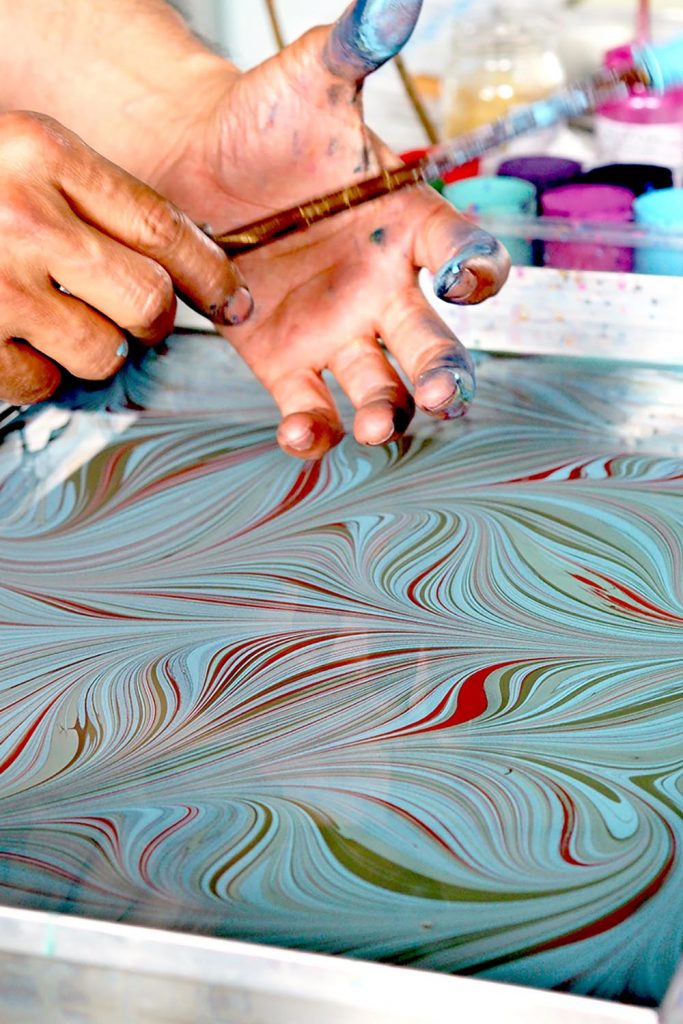
Deep red droplets fall from a wooden brush made from rosewood and natural horse hair. The droplets spread rapidly as they hit the water, creating huge circles that glide across the metal tray. Within seconds, the intense red hue has disappeared – the pigment particles have spread so thinly, they have lost their most fundamental essence – colour.
Written by Sonya Ahmed, 19 May 2020
Ebru Art Studio
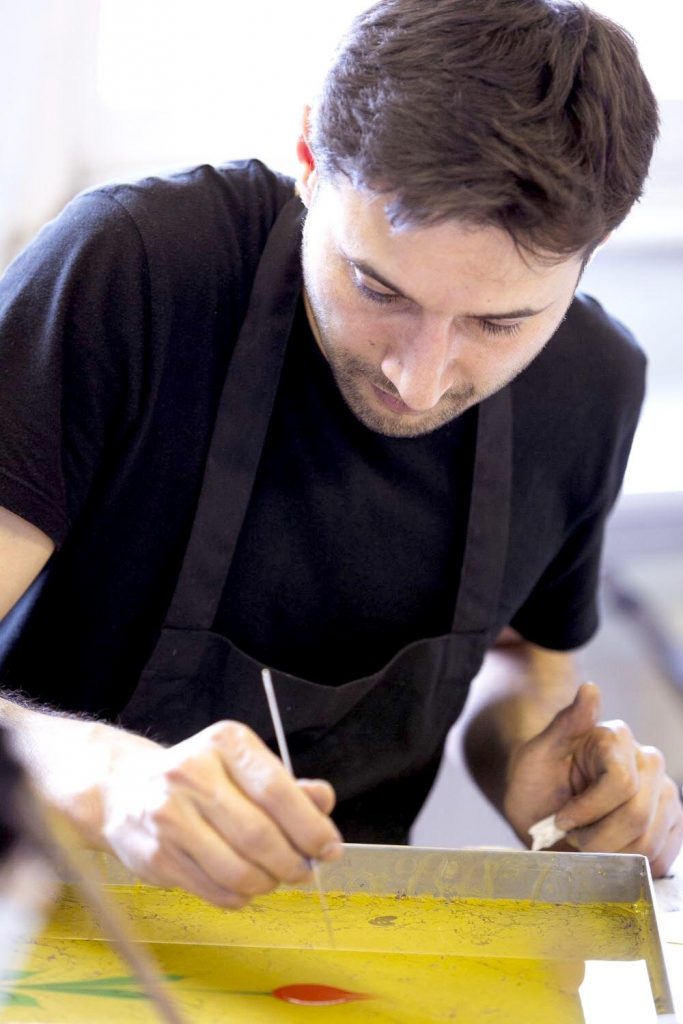
I am in a brightly lit studio in North London, with artist, Hayrettin Kozanoglu. Every available surface seems to have been covered with newspaper. Heaters have been placed around the room and it is uncomfortably hot. The heat accentuates the pungent smell of ox gall – the digestive juice of cattle – which is mixed into the paints to allow them to spread.
Hayrettin turns off a heater and explains that the room must be kept warm for the paints. Over the next few weeks, I will learn more about the water, the paints and their very specific needs and requirements.
Ebru, a form of painting on water, has been practised in Turkey for over 500 years, having arrived there from the Far East. Generation after generation of Sufi masters developed and passed down this spiritual and mystical art form, supported and promoted by wealthy Ottoman rulers. As with other Islamic art forms, ebru artists sought spiritual awareness and inner knowledge, through the outward expression of physical beauty.
Hayrettin has been studying and practising ebru for nine years. He has learned and developed his technique under ebru masters in Turkey. Quietly spoken, he exudes a calm demeanour, which seems fitting for such a tranquil art form.
The Elements of Ebru
As Hayrettin produces pattern after pattern, he explains the processes involved in preparing the elements of ebru. The watery canvas, called the ‘size’, is a gel-like mixture of water and carageenan – seaweed extract – which has to be prepared at least a day prior to the painting. At room temperature, it will only last a day or two before starting to degrade.
The watery ‘size’ prevents the paints from sinking to the bottom of the tray. As Hayrettin does not have running water in his studio, he carries the prepared solution up several flights of stairs before each session. I feel humbled by the effort required just to produce the canvas, but this is only one part of the preparation.
The pigments used in traditional ebru are derived from natural sources – indigo from the Indigofera plant, Indian red, an iron oxide extracted from the earth, and ultramarine from crushed lapis lazuli gemstones. Once in powdered form, the pigments are crushed by hand, between blocks of marble, and water is added to create a creamy consistency.
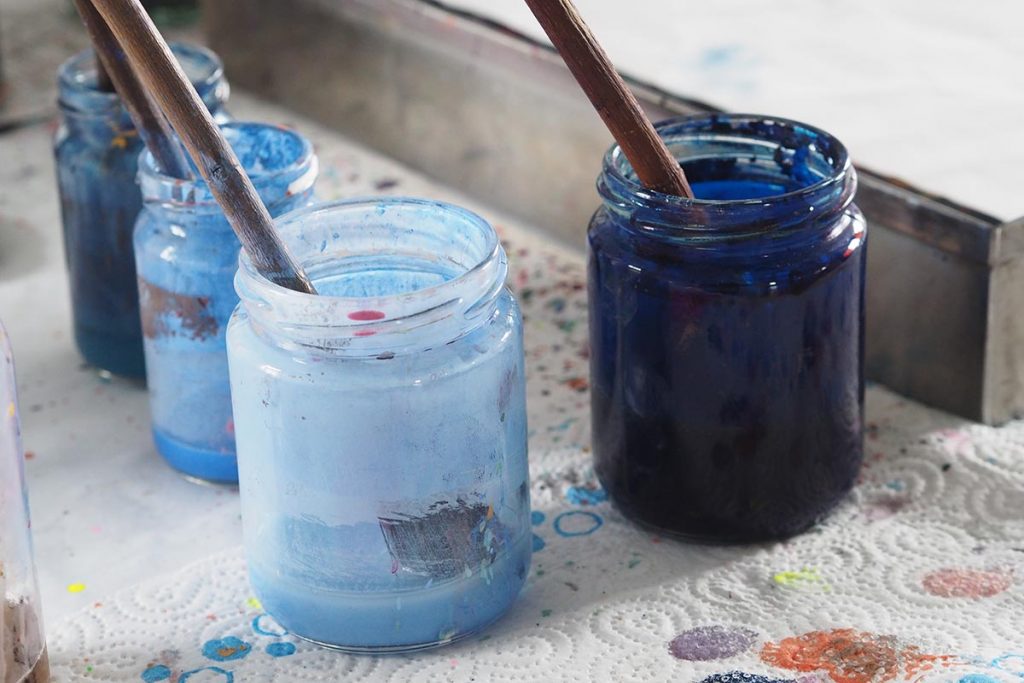
Hayrettin sources the finest, natural pigments from Turkey. They have already been crushed, but there is more to do before the paints can be used. Ox gall is mixed into the paint to weaken the physical bonds between the particles. With this reduced surface tension, the paints spread in the blink of an eye and appear to defy natural laws – this is what makes ebru so hypnotic to watch.
The pigment particles do not dissolve in water. They remain suspended as tiny solids. If the natural earth sources are impure, if they are not crushed adequately or if the ox gall is not added precisely, the particles will not spread. Instead, they will sink and remain suspended in the lower layers of the gel. The training and experience of the artist is key to the preparation of the the paint and ox gall mixture.
Painting on Water
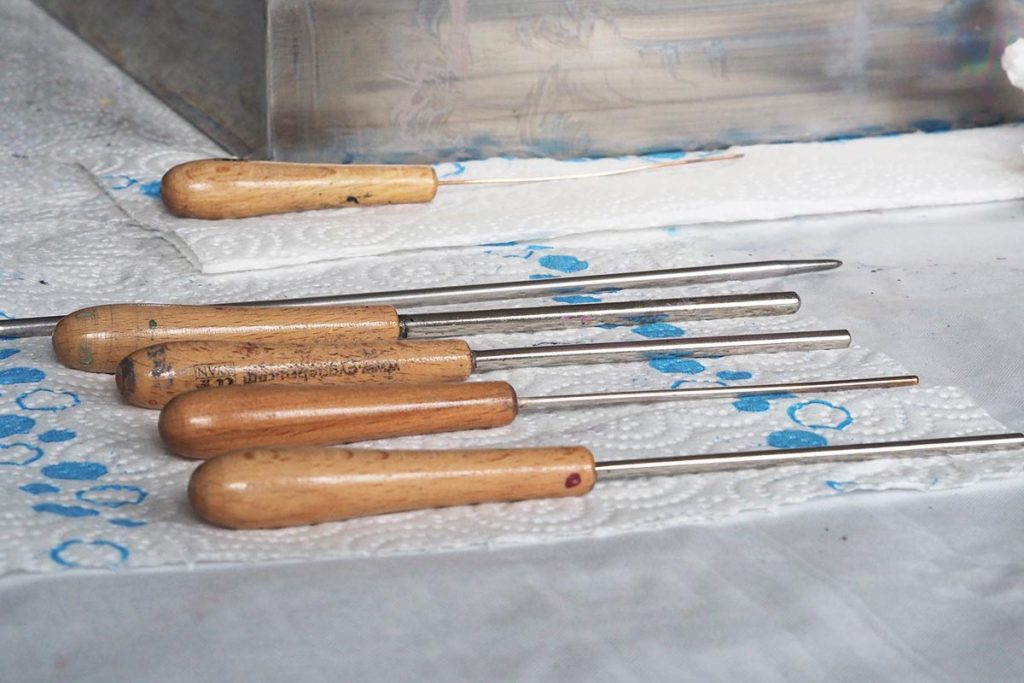
After such a long process of preparation, the painting process itself is surprisingly quick. Hayrettin adds colour after colour, completing an entire painting in just a few minutes. He works fast, as the paints will not slow down or pause, for him to consider his next move. Unlike working on paper or canvas, he cannot place a colour exactly where he wants to and he cannot take time to build up shades of colour.
With many years of experience, it’s clear that he is familiar with the character of his paints. He knows which pigments are strong enough to overpower the others, which ones will end up as crackled lines and fractures, and how the intensity of the colours will change, based on the density of the pigment and surface tension of the paint.
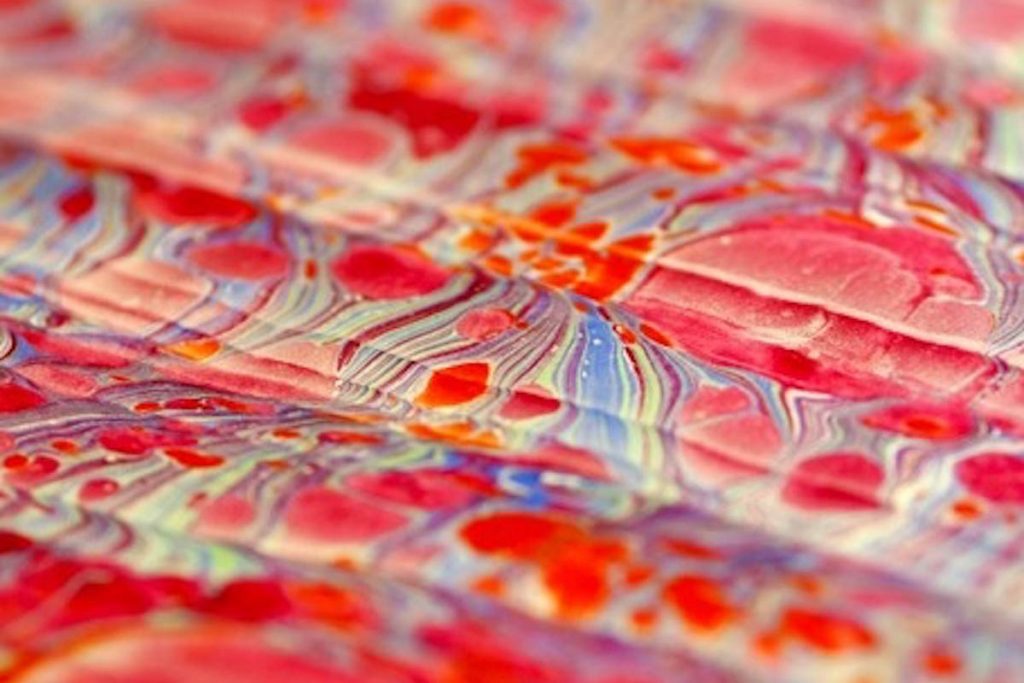
The process is mesmerising to watch. The final designs are beautiful, but it’s the movement and dynamism of the paint, the feeling that the paints are alive, that really draws you in and makes it so difficult to look away.
Watching the creation of the designs, understanding the various elements that must be perfectly prepared to allow just a few minutes of painting, creates a sense of awe and respect, over and above the aesthetic beauty of the final print.
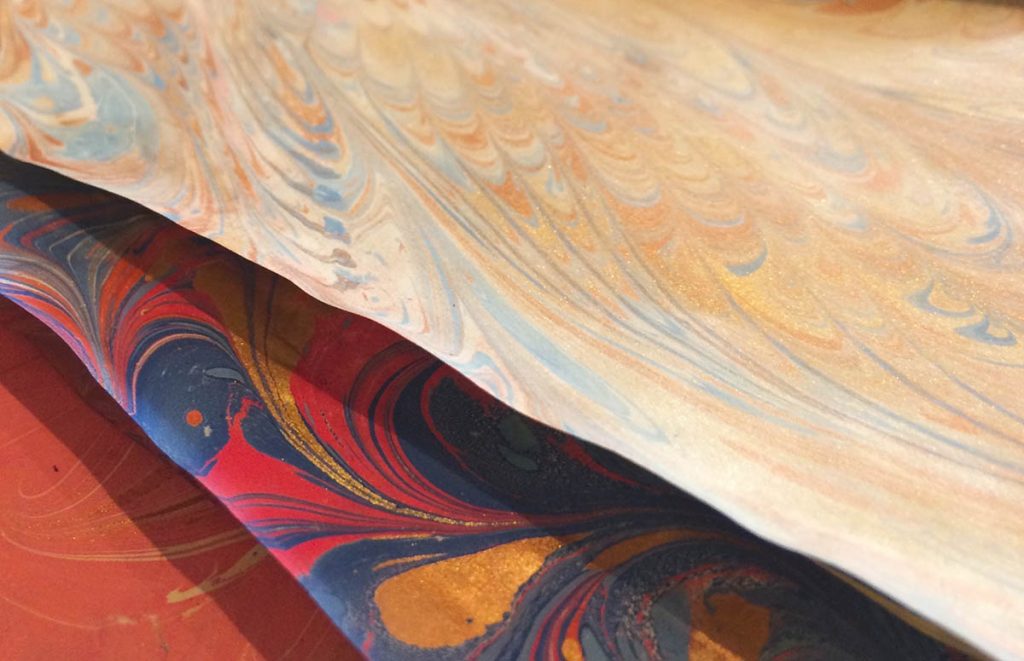
When all the colours have been added, a single sheet of paper is used to lift the design from the size. The paints transfer to the paper, leaving minimal residue in the tray. Hayrettin leaves the prints on newspaper, to dry. The paints are so much brighter on the paper, than in the murky, metal tray, that the final print always comes as a surprise.
As the paper dries, the colours change once more, and the pigments, which may have originated from a quarry in Italy, a plantation in India, or from the highlands of Peru, finally come to a rest.
Find out More
I met with Hayrettin at the Yunus Emre Institute in London, to develop exclusive designs for a range of scarves. Hayrettin offers individual and small group workshops as well as longer, weekly courses.
Check out his social media pages.
Visit the Yunus Emre website for other courses related to Turkish art and culture.