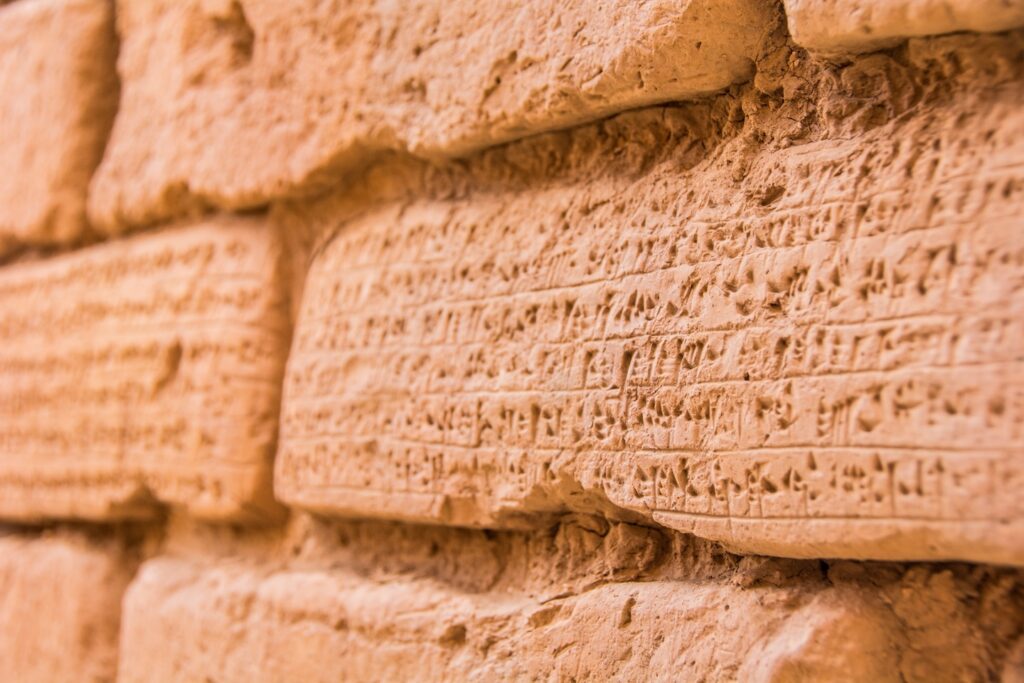
Fragilty and endurance
A small clay tablet from the Late Uruk period, sits in the British Museum in London, its surface covered in cuneiform, the earliest writing known to man. Over five thousand years old, the tablet emerged from the cities of southern Mesopotamia, in present-day Iraq.
The tablet does not contain a grand historical narrative or a profound philosophical treatise. The wedge-shaped impressions record something entirely ordinary – allocations of beer and grain to workers. Yet it is precisely this ordinariness that makes it remarkable. In preserving the routines of normal, daily life, the tablet somehow collapses the gulf of time between its makers and its modern day observers.
Early tablets were not intended to survive across millennia. They were practical, administrative tools, that could simply be soaked in water and reused. This repeated erasure formed a natural part of early writing culture. Tablets intended for preservation, such as those containing royal inscriptions or religious texts, were fired in kilns at high temperatures, but the overwhelming majority were simply dried beneath the Mesopotamian sun. Despite this, hundreds of thousands of ancient tablets endured.
Mesopotamian cities were repeatedly destroyed, rebuilt and buried over centuries of warfare and political upheaval. Fires consumed temples and administrative buildings but hardened the clay tablets, transforming fragile records into durable ceramic objects.
When the scribes of Ur gathered mud from the banks of the Euphrates and kneaded it into smooth tablets, they could not have imagined that their impressions would survive beyond the collapse of their cities and languages. The same material that could be erased by water, became, through accident and catastrophe, one of the longest-lasting carriers of human memory.
a script and language disappear
Cuneiform was not a language, but a system of writing using a logophonetic script, where some symbols represented words and others represented sounds. Cuneiform was used across multiple civilisations over thousands of years to write languages such as Sumerian, Akkadian and Old Persian. Tiny wedge-shaped marks were pressed into soft clay by highly trained scribes, who had memorised hundreds of signs, the meanings of which shifted, depending on the language and context.
Over centuries, the complex cuneiform script was gradually displaced by Aramaic, an alphabetic script that was simpler and faster to use. By the first century AD, cuneiform had disappeared entirely. The Sumerian language, already ancient by the time of the Assyrian king, Ashurbanipal, in the seventh century BC, vanished from human understanding for almost two thousand years.
Civilisations rose and fell around these silent, enduring objects. People encountered the strange wedge-shaped inscriptions carved into ruins but could not longer understand them. It was not until the nineteenth century that scholars began deciphering the lost languages of Mesopotamia and recovering voices from a distant past.
A crucial breakthrough came from the discovery of the Behistun Inscription, a royal decree carved into a cliff face in present-day Iran, around 520 BC. The inscription was written in three languages: Old Persian, Elamite and Akkadian. By deciphering Old Persian, the youngest and most accessible of the three scripts, scholars gradually unlocked older forms of cuneiform and eventually recovered Sumerian itself.
Humanity was thus able to read a script that was over five thousand years old, reaching back through time to the very edge of writing itself.
The materiality of memory
For much of modern scholarship, the focus of cuneiform studies centred on translation and textual content. Increasingly, researchers have turned their attention toward the materiality of the tablets and the embodied practices involved in their creation.
Clay itself carries a strange contradiction. It is among the most common materials on earth, formed through the slow geological breakdown of rock over immense spans of time. Soft, malleable and easily dissolved in water, it hardly appears a suitable repository for preserving civilisation across millenia.
Yet clay possesses an extraordinary capacity for transformation. Soft enough to receive the impressions of thought, once exposed to fire, it becomes one of the most durable materials humanity has ever used. The same material that can be reshaped by hand, can also survive for thousands of years beneath the earth.
Though fired clay can endure for millennia underground, excavation and exposure introduce new vulnerabilities. Changes in humidity, handling, transportation and microscopic erosion threaten the shallow wedge-shaped inscriptions pressed into their surfaces. Their survival depends upon continuous acts of care.
Over time, their identity has shifted. First, they were ordinary instruments of record keeping, embedded in the rhythms of daily life. Then they became unreadable remnants of a collapsed world. Later, they were recovered as archaeological objects and gathered into archives, far from their place of origin.
In this sense, the Late Uruk tablet in the British Museum, has no fixed essence. Its meaning emerges from the relations in which it is embedded. It is shaped by the scribe who formed it, the fire that hardened it, the archaeologist who uncovered it and the museum that now holds it in a suspended state – preserved, catalogued and studied, yet separated from the geography, climate and cultural world in which it was created.